


























Views
Downloads

Vowel Team Word Recognition | Essential Grade 3 Phonics
Paste this activity's link or code into your existing LMS (Google Classroom, Canvas, Teams, Schoology, Moodle, etc.).
Students can open and work on the activity right away, with no student login required.
You'll still be able to track student progress and results from your teacher account.
Strengthen foundational reading skills with this comprehensive vowel team recognition worksheet designed for Grade 3 and Grade 4 students. This resource focuses on the common vowel teams 'ai', 'ay', 'oi', and 'oy', helping learners bridge the gap between phonemic awareness and written fluency. Students will engage in a multi-sensory approach to master these complex spelling patterns through reading, tracing, and independent writing.
At a Glance
- Grade: 3 · Subject: English Language Arts
- Standard:
CCSS.ELA-LITERACY.RF.3.3— Know and apply grade-level phonics and word analysis skills in decoding words- Skill Focus: Vowel Team Identification (ai, ay, oi, oy)
- Format: 3 pages · 16 tasks · Answer key included · PDF
- Best For: Independent Phonics Practice or Literacy Centers
- Time: 20–30 minutes
What's Inside
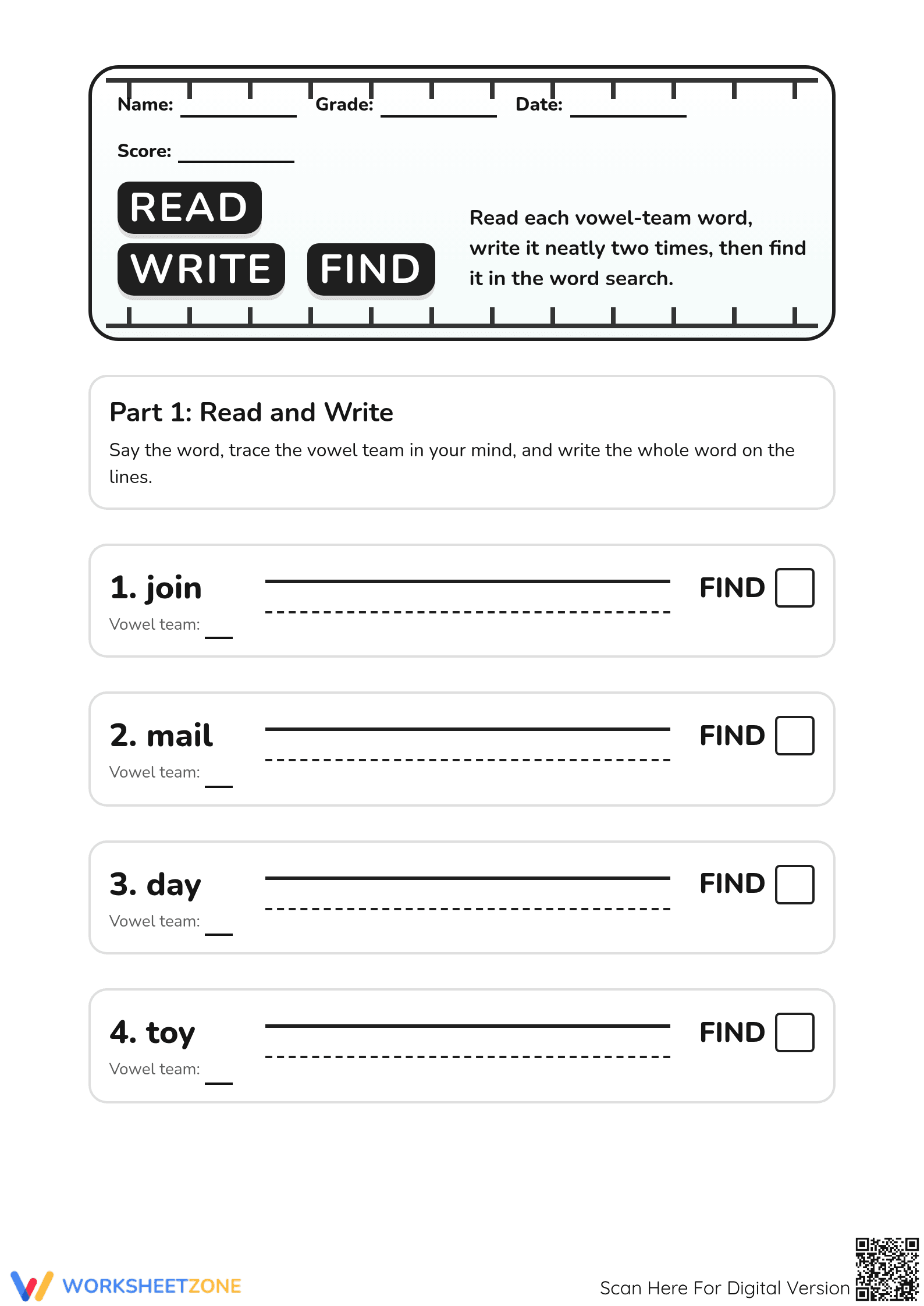
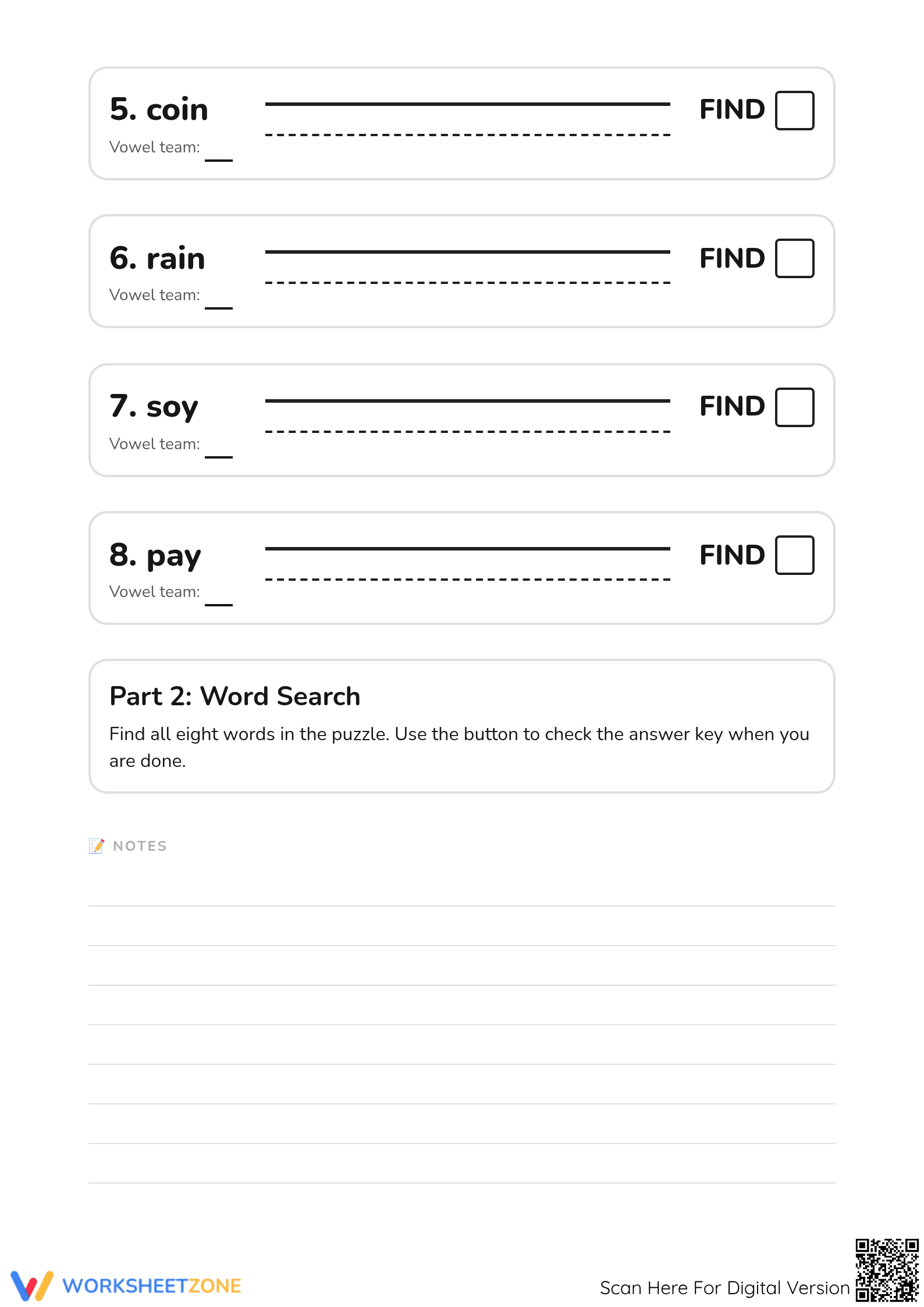
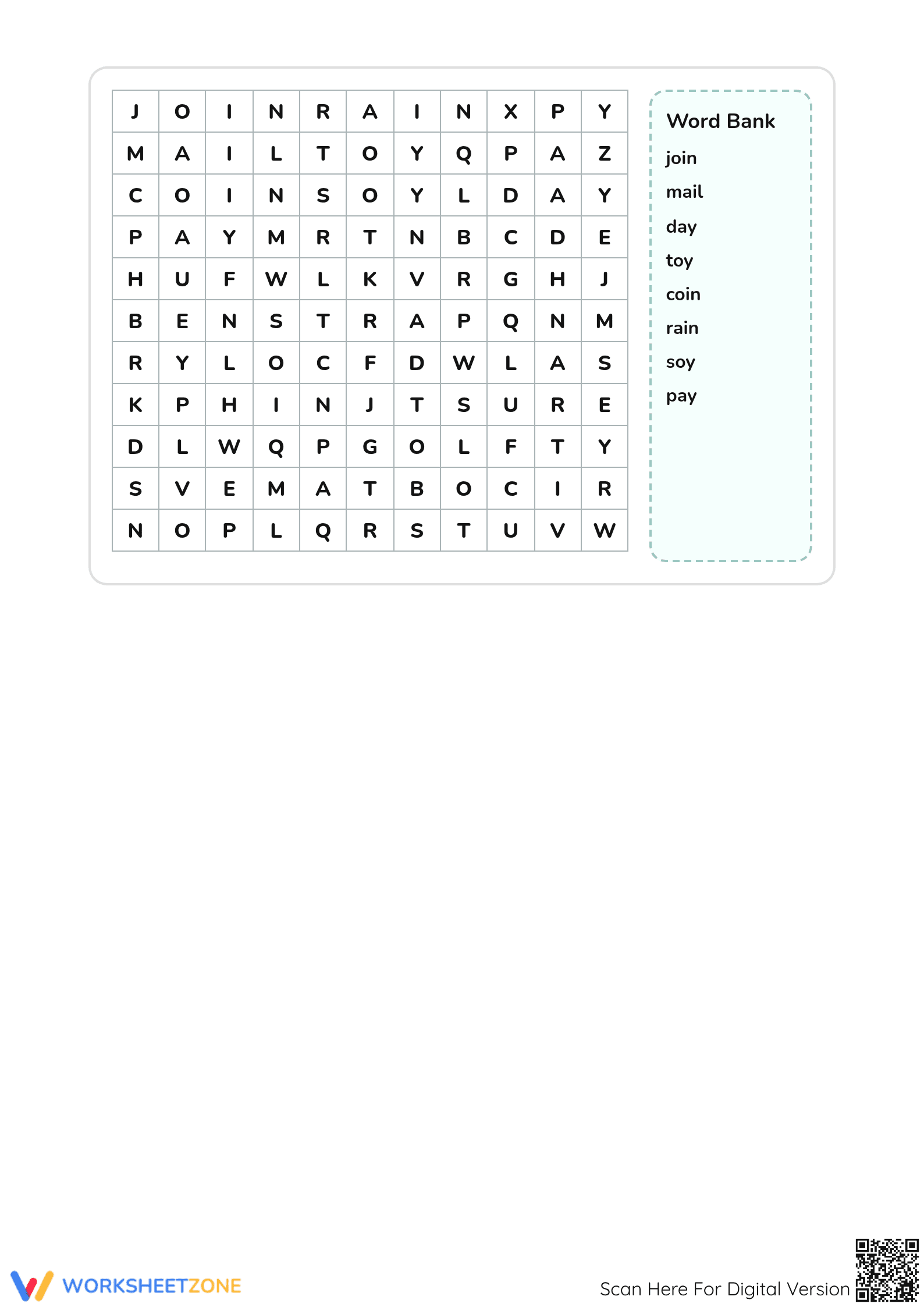
This 3-page PDF packet provides a structured environment for phonics mastery. The first two pages feature eight target words (join, mail, day, toy, coin, rain, soy, pay) where students must identify the specific vowel team, write the word twice on primary-ruled lines, and check off their progress. The final page includes a high-interest word search and a clear word bank to reinforce visual recognition and spelling accuracy in a low-stakes, engaging format.
Zero-Prep Workflow
- Print (1 minute): Select the three pages and print enough copies for your literacy block or homework folders.
- Distribute (30 seconds): Hand out the packets; the self-explanatory "Read, Write, Find" instructions require minimal teacher introduction.
- Review (1 minute): Use the included answer key to quickly verify student work or allow students to self-correct their word search results.
This streamlined workflow makes the resource an ideal choice for emergency sub plans or morning work transitions where teacher bandwidth is limited.
Standards Alignment
This resource aligns primarily with `CCSS.ELA-LITERACY.RF.3.3`, which requires students to know and apply grade-level phonics and word analysis skills in decoding words. By isolating vowel teams like 'oi' and 'ay', students build the decoding stamina necessary for reading multisyllabic words. Both standard codes can be copied directly into lesson plans, IEP goals, or district curriculum mapping tools.
How to Use It
Assign this worksheet during the "You Do" phase of a gradual release lesson on long vowel patterns. It serves as an excellent formative assessment tool; as students work, circulate to observe if they can correctly isolate the vowel team (e.g., writing "oi" for "coin") before writing the full word. Most students will complete the full three-page sequence within 25 minutes, making it a perfect fit for a standard literacy rotation.
Who It's For
This packet is tailored for third-grade students mastering new phonics rules and fourth-grade students requiring targeted intervention or RTI support. It pairs naturally with an anchor chart displaying vowel team rules or a direct instruction lesson on diphthongs. The clear layout is particularly helpful for English Language Learners (ELLs) who benefit from the visual repetition of word forms.
According to the RAND AIRS 2024 report on foundational literacy, repetitive orthographic mapping—the process of turning printed words into sight words—is significantly enhanced when students physically write and then search for target phonemes in varied contexts. This worksheet utilizes that research by requiring students to move from isolated vowel team identification to whole-word construction and finally to visual scanning within the word search. By engaging with the standard CCSS.ELA-LITERACY.RF.3.3 through multiple cognitive channels, students are more likely to move these vowel patterns into long-term memory. This structured approach ensures that phonics instruction is not merely a rote exercise but a meaningful step toward reading fluency and spelling mastery in the upper elementary grades.


